
| Safety Turtles Home |
| Product Design |
| Ease of Use |
| Home Alarm Systems |
| Man Overboard Alarm |
| Integrator Base Staion |
Using Safety Turtle with Fresh Water Shorelines
| User Guides (PDF) |
| Warranty & Service |
| Salt Water Pools |
| Fresh Water |
| Battery Pack and Travel Bag |
| Testimonial and Press |
The coverage of a shoreline will always be limited, because the Base Station alarms on the presence, not the absence, of a signal. The User must be aware of the limits of coverage.
In a clear line of site, with the Base Station at waist level or higher off the ground, typical range is 150 feet (45 meters). So a Base Station situated at a shoreline can potentially cover 150 feet (45 meters) in each direction, for total of 300 feet (90 meters) [Actual coverage varies and must be measured.]
If the Base Station is set back from the shoreline, the length and in some cases the continuity of shoreline coverage will be reduced by:
* The set back distance
* Signal reduced or blocked by trees, ridge, etc.
* Signal reduced or blocked by building exterior (if located indoors)In all cases and with all water hazards, coverage must be tested at set up using test mode.
In the case of a waterfront, there are basically three options in setting up.
Option 1 - Base Station is located in the residence. This is most suitable when the residence is within 30 feet (10 meters) of the water and the shoreline is completely visible. Otherwise, shoreline coverage will be considerably reduced. The Base Station should be high enough to clear any ridge blocking view of the shoreline. Locating outside on a deck will provide best coverage. Follow other instructions in the User Guide.
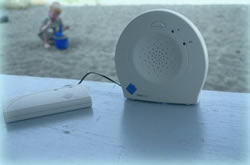
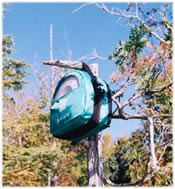
Option 2 - One or more Base Station(s) are located by shoreline, up to 300 feet (90 meters) apart. This provides up to 300 feet (90 meters) of coverage per Base Station. Each Base Station requires AC power and a canapé or enclosure that protects it from rain but doesn't diminish loudness. The Base Station should be 3 feet (1 meter) or higher above the ground, on a platform, or hanging. The alarm must be audible in the residence, or as required by the caregiver(s).
Option 3 - Option 3 This option overcomes the shoreline and audibility coverage limitations of Options 1 and 2 respectively, but is more expensive. Primary set up is identical to Option 2, except an Integrator Base Station(s) rather than Base Station(s) is used. The Transmitter plugged into an Integrator Base Station radios the Remote Alarm, so alarming simultaneously occurs both at the shoreline and in the residence. See diagram.
A longer cable from the 9-volt AC wall adapter is available from Terrapin to facilitate Options 2 and 3.
If electricity is not available at the residence, a solar-charged battery unit may be used to power the Base Station, which draws only 75 milliamps [when not alarming]. Alternatively, Turtle Power can provide 9 hours per day operation, when charged nightly by the car battery, using a Terrapin-supplied 12-volt cigarette lighter adapter.